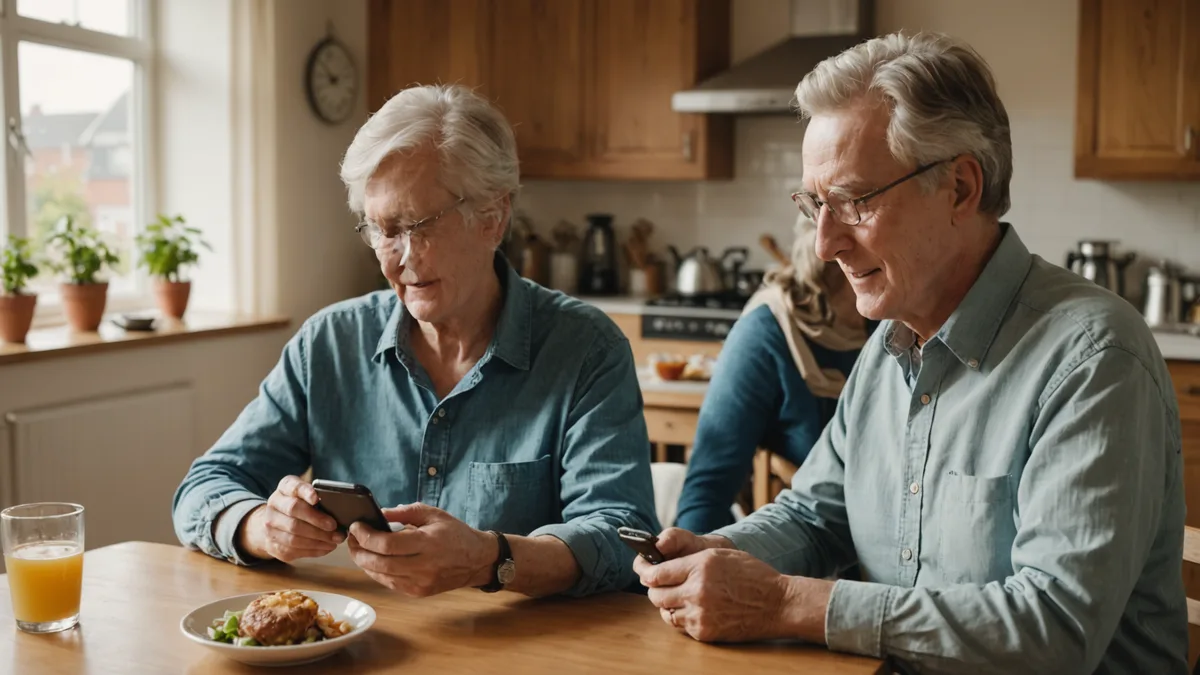
Many adult children describe the same awkward moment: they know their parent is getting more scam calls, they want to say something, but they are not sure how to start without sounding like they're questioning their parent's judgment or treating them like a child.
That hesitation is real and understandable. The conversation carries a subtext that the person being talked to can feel, even if it is unintentional: "I don't think you can handle this." Parents who have raised families, built careers, and managed finances for decades can reasonably resent the implication. So it often does not happen, or it happens badly, and the opportunity for genuine protection is missed.
Getting this conversation right matters as much as any technology you might install on a parent's phone. Here is how to approach it in a way that actually lands.
Start with the Scammer, Not the Parent
The framing matters enormously. "I'm worried about you getting fooled" puts the vulnerability on the parent. "These callers are getting so sophisticated that everyone is a target now" puts the problem where it belongs, on the scammer's capabilities, not on the recipient's caution.
Both framings might be trying to accomplish the same protective goal. But one invites defensiveness and one opens a conversation. Leading with the sophistication of the scam, rather than concern about a person's vulnerability to it, changes the dynamic from "I'm looking out for you because I'm worried" to "have you heard about this thing that's happening to everyone?"
You might say something like: "Have you seen anything about AI voice cloning? Scammers can now fake someone's voice from a short recording. They've been calling grandparents pretending to be grandchildren in emergencies. It's genuinely hard to detect." That framing invites a discussion between two curious adults about a concerning trend, not a lecture.
Share a Specific Story, Not a General Warning
Vague warnings do not stick. "Be careful about phone scams" is something most people have heard enough times that it no longer registers. A specific, concrete story is different.
If you know of a case, share it in detail. If you read about one, bring it up. "I read about a family in Ohio where the grandmother got a call from what sounded exactly like her grandson saying he'd been in an accident in another city. The voice was fake, generated by an AI. She called her daughter before sending any money, which stopped it." That kind of account is vivid enough to create a mental model: "So this is what it looks like."
Stories work better than statistics for this purpose. We are built to remember specific events better than abstract numbers. A single detailed example will influence behavior more reliably than being told that millions of seniors are affected each year.
Give Them Specific Scripts and Rules, Not Just Awareness
Awareness without action guidance leaves people uncertain about what to actually do when a suspicious call arrives. Tell your parent specifically what to say or do:
- "If anyone calls claiming to be in an emergency and needs money, tell them you'll call back on their regular number and hang up."
- "No real government agency will ever call and demand immediate payment of any kind."
- "If anyone asks you to pay anything in gift cards, it is a scam. Hang up."
- "It is always okay to hang up and call us to check."
That last one is important. Many older adults worry about being rude by hanging up on someone, even a caller who is threatening them. Explicitly giving permission to be rude, naming it as the right choice in certain situations, is something that can remove a real hesitation in the moment.
Establish a Family Code Word Together
This is one of the most effective low-tech protections against the grandparent scam and its voice-cloning variants. Pick a code word or phrase that every family member knows, something odd enough that a scammer could never guess it. If anyone calls claiming to be a family member in an emergency, asking for the code word immediately reveals whether the caller is real.
The key is doing this as a family activity, not installing it as a rule. "Let's come up with a code word that all of us will know, so if anyone ever gets a strange call from one of us, we can verify it's real." That framing makes it a family decision, not something being imposed on one person.
On the code word: Pick something memorable and specific, like a meaningful childhood location or a pet's old name. Avoid common words. Write it down somewhere safe and share it with every adult in the immediate family.
Installing Protective Apps: How to Introduce Technology Without Condescension
If you want to set up something like Savi Security on a parent's phone, the conversation about the app should be separate from a conversation about their capability to handle calls. The technology is a tool, not a verdict on their judgment.
Try framing it as something you want them to have for the same reason you want them to have smoke detectors: not because you expect a fire, but because the tool is quiet, unobtrusive, and removes the burden of being vigilant every moment. "It runs in the background and just lets you know if something about a call looks like a known scam pattern. You still make every decision. It just gives you an extra heads-up."
Offer to set it up yourself, in person, during a visit. Doing it together also gives you a natural opportunity to show them what the alerts look like and how to dismiss a false flag on a legitimate call. Their comfort with the app is higher when they have seen it in action with you present, rather than discovering it alone when an alert fires.
What to Do If the Conversation Does Not Go Well the First Time
Not every parent will receive this well on the first attempt. Some will interpret even a carefully framed conversation as an attack on their independence, and they will push back. That is okay.
Do not pursue the point in the same conversation. Planting information is sometimes enough. The goal is not to win an argument or change behavior immediately. It is to make sure the information is in there somewhere, available when a suspicious call arrives. "I hear you, I'm not saying you can't handle it. I just wanted you to know about the voice cloning thing specifically because it is new and genuinely hard to spot."
Come back to it later, through different angles. Forward a news article about a family that was targeted in a similar area. Mention a neighbor who had a close call. Repetition from different directions builds the mental model without any single conversation needing to accomplish everything.
The goal is a parent who, when a strange call comes, has enough in their mind to slow down before they act, not one who simply follows your instructions because you told them to. The first kind of protection lasts; the second kind only works when you're watching.